So I thought I would make a quick guide for all of the foreigners coming to the wedding. So first up all the infos to the location and accommodation, then a guide to public transport in Austria generally, and finally a best of Vienna in two or three days. I’d love to show everyone around just before or after the wedding, but that might not be possible.
The wedding ceremony starts at 13:00 Central European Time, end time is very open 😉
The Location: Burg Lockenhaus

The entire wedding is taking place in Burg (Castle) Lockenhaus. Here’s their website. EVERYTHING will be taking place here, including ceremony, reception, dinner, etc. Lockenhaus is a relatively small town about 1:20 by car from Vienna/Vienna Airport, so I would advise you to spend the night (maybe even the night before) in the castle itself. The rooms are in the castle itself or the walls and are quite reasonable. They have enough rooms for all our guests and the rooms are all blocked off for the wedding. Unfortunately we can’t cover accommodation for all 80+ guests, so please organize your own rooms by the end of January. There are three types of rooms, please note that the “castle rooms” are reserved for close family. You make your reservation by emailing here: rezeption@ritterburg.at, just mention that you are attending the Pichler-Unterberger wedding. We hope to see everyone at breakfast the next day 🙂
GETTING THERE
Address:
Eugen Horvath Platz 1
7442 Lockenhaus
47° 24′ N , 16° 25′ O
The closest airport is Vienna International Airport (Wien Schwechat). While trains and other public transport in Austria are generally really good, the castle is a bit hard to reach. Hiring a car from the airport or central Vienna is probably the way to go — there is also free parking at the castle. There are quite a few people coming from overseas, let us know if you are looking for a lift club.
Travelling in Austria
Arriving from the airport:
Assuming you are not renting a car — A taxi or Uber costs around €35-€50, so I would recommend taking the normal train. Just follow the signs down the ramps to trains and find the ÖBB ticket machine, a trip costs around €4,50 per person. Looks like this:
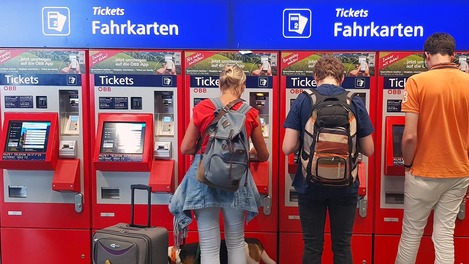
If you enter your nearest bus or subway station, then the ticket also includes switching lines. The CAT train is a premium line and is NOT included, all of the other trains will either go to either Wien Hauptbahnhof (Main trainstation) or Wien Mitte (central Vienna). Google maps or the ÖBB website are great for finding connections. Vienna has its own public transport network (Wiener Linien), but the airport is just outside the zone, so you have to take the federal train ÖBB. (More about that later)
Cars: Austrians drive on the right! Take care when turning and especially when entering traffic circles. Also interesting, the green traffic flashes green 5 times before turning orange. Red lights also briefly turn orange before turning green.
On the Autobahn (highway) your car will need a vignette, but all rentals should have one. Austrian Autobahn is unfortunately not the same as the unlimited German one, max speed 130 km/h. Other roads are generally 100, and cities are max 50.
Vienna is unfortunately quite the headache with parking, there is NO free parking in the entire city between 9:00-22:00. (Between 22:00 and 9:00, weekends and public holidays are generally free). The inner city is mostly a pedestrian zone anyway, so I would recommend leaving the car at the hotel or else finding parking garages.
Trains and Vienna public transport:
Vienna has its own public transport network and tickets, all managed by Wiener Linien. Tickets allow you to go with ALL subways, buses, trams and even bigger trains within city limits. Basically only taxis and tour buses are excluded. Single journeys cost €2,40 and are valid for 80 minutes after validation, which means that you can take any route to your destination. (Validation is either done when buying from the machine or you stamp it yourself in one of the little blue boxes). The 24- and 48-hour tickets are quite worthwhile. Tickets machines are located in subway stations and in the trams (the trams sometimes only accept coins). I think that bus drivers also sell tickets. Wiener Linien also lets you rent bikes and drop them off at different stations. Vienna is very pedestrian friendly, particularly the inner city. There are no ticket checks in Vienna, instead have “undercover” conductors who go around checking tickets. While you can obviously risk going without a ticket, the fine is over €100….
If you don’t want to leave Vienna, then you can skip this part.
Almost all intercity trains are run by (or at least can be booked though) the ÖBB . This includes international trains. Almost all reservations are valid for an entire day and are NOT limited to a specific train! A seat reservation costs extra and is then obviously restricted to a specific train connection. Still, it’s always a good idea to check which connection is faster, some trains are much slower or have more stops. Most trains have free wifi and charging ports.
Trains have gotten quite pricey if you don’t a Vorteilscard (costs between €66 – €100, but can quickly be worth it if you’re taking a very long journey). The Westbahn is another train company that is occasionally cheaper. For longer journeys it might be worthwhile to try booking over their national train network or just take a bus. Flixbus has super cheap tickets to Prague, Bratislava, Italy, etc. They also travel between Austrian cities.
Sightseeing in Vienna
May/June is a beautiful time to visit Vienna. The city has 23 districts which are all quite different (we live in the third). So the first district is the old town and probably where you will want to spend most of your time. The Ring street is a oneway road surrounding the first district and links most of the most exciting sights. So you could walk from the Opera along the Ring to the Hofburg, Parliament, City Hall, and University in about an hour. Churches in Austria are generally all free, unless there is an exhibition or something similar.
Quick German guide:
This ß thing is a double s, is pronounced like the s in skate.
These dots above letters ü,ö,ä are called umlauts and are pronounced differently, as if you tried to combine the letter with an eh sound.
Straße, Gasse, Weg = street, road, way
Dom = cathedral
Kirche = church
Platz = square or place
Must sees in Vienna:

Stephansdom: The “main” church in Vienna. You can hike up the (very long, tight, and windy) stairs up the main tower. (Fun fact: Stephansplatz is pretty much the center of Vienna.
Graben and Kärtner Straße: The two fancy shopping streets of Vienna. Both start at Stephansplatz, the Kärtner Straße goes all the way to the opera house. Lots of shops, boutiques, etc.
Hofburg and Heldenplatz: The Hofburg is a HUGE building complex where the imperial court was held. A lot of official business and offices are still located here. (President and Chancellor amongst others). The Hofburg houses the national library, the imperial treasury museum, the Spanish riding school (where the famous white Austrian Lippizaner horses are kept and perform), and some other museums. The Volksgarten is a very pretty garden on the end of the Heldenplatz (the huge ceremonial square in front of the Hofburg).
Oper (Opera house): Standing tickets are not as expensive as you might expect, but they might be closed during summer.

Karlskirche: Connected to the opera house by a subway station. One of the only churches which requires you to pay for entrance. The Vienna Museum was constructed next-door. Karlsplatz is the largest transport hub in Vienna.
Museumsquartier: Very hip complex with lots of different museums, galleries, open-air exhibitions, and cafes. The twinned museums of natural history and art history are just in front and opposite the Hofburg.
Mariahilfer Straße: The central shopping district. It’s a long street (about 1,8 km) connecting the Hofburg/Museumsquartier to the west train station and is filled with shops, cafes, etc.
Parliament: Freshly renovated, you can also go into the visitor area for free. You just need to register through a QR-code and go through a metal detector.
Rathaus (city hall): Probably my favourite building in Vienna. There are often big events and festivals in the square in front of it.
University of Vienna and Votivkirche: Definitely worth going through the front door. Walking around the arcade makes you feel very clever indeed. The gothic church next door spent the last 10+ years being renovated and is finally open again.
Schönbrunn: The old summer imperial residence. The palace is inspired by Versailles and is worth at least seeing from outside. Schönbrunn has a huge flower garden at the back and an enormous park with the oldest zoo in the world. Might be worth taking a carriage through the gardens.
Belvidere: Two palaces with a flower garden in the middle. The palaces are also art exhibitions, the upper building is the main Klimt painting exhibition. The botanical gardens are also next door.
Naschmarkt: Open-air market with lots of fresh food and fun restaurnats.
Donaukanal: The Danube was a very feisty river and kept moving around and flooding everything, so the emperor (and then later city administration) split the river into different channels. The canal is where the oldest branch of the river used to flow. Walking along the canal you see a lot of street art, clubs, bars, etc. (Schwedenplatz is a good start location, is a 10 minute walk from Stephansplatz)
Prater: There are two parts to the Prater, first of all an enormous park with a 4,5 kilometer tree-lined pedestrian boulevard. The second and more important part is the so-called Würstelprater (sausage Prater), which is basically an amusement park. Entry is free, and you pay for the rides separately. The Schweizer Garden is probably the most famous traditional Austrian restaurant/beer garden in Vienna.
It is possible to visit all of these places in two days, but three might be more reasonable. Vienna also has many museums and art galleries, the Albertina and Natural history museums are strong recommendations.
Some of my favourite Viennese restaurants or cafes:
Cafe Gerstner (fancy cafe opposite the opera house)
Schweizerhaus (traditional Austrian beer garden)
Kleine Steiermark (traditional Austrian beer garden)
Stöckl im Park (traditional Austrian beer garden)
The 7th district is the hipster area and also has a lot of really fun and quirky shops and restaurants.